I spent thirty-five years in airline cockpits, and here is a confession you'll hear from a lot of pilots if you catch us in an honest mood: before we loved airplanes, most of us loved trains. Both are big machines with personalities.
Both reward a crew that respects procedure and punishes one that doesn't. And both, at their best, become legends — names that outlive the companies that built them.
Today I want to walk you through five of those legends, the same five that keep showing up on my drafting table when I design railroad prints for the shop.
Union Pacific Big Boy No. 4014: the heavyweight champion
If railroading has a queen of the skies, this is it. The Union Pacific Big Boys were 4-8-8-4 articulated giants built by the American Locomotive Company — twenty-five of them, delivered between 1941 and 1944 to drag heavy wartime freight over the Wasatch grades.
The numbers still stop me cold: roughly 133 feet over the couplers and about 1.2 million pounds in working trim, with a hinged frame so all that length could negotiate a curve. For comparison, that's longer than the fuselage of most airliners I flew, and a great deal heavier.
Eight Big Boys survive, but only one lives. Union Pacific pulled No. 4014 out of a California museum, hauled it home to Cheyenne, and after a multi-year restoration returned it to steam in May 2019 for the 150th anniversary of the transcontinental railroad's completion. It remains the largest operating steam locomotive in the world.
Standing trackside as a Big Boy rolls by is the closest thing railroading offers to a heavy jet starting its takeoff roll — pure mass, thunder, and intent.
Flying Scotsman: the most famous locomotive in the world
Built at Doncaster Works in 1923 to Sir Nigel Gresley's design for the London & North Eastern Railway, No. 4472 took its name from the 10:00 a.m. London-to-Edinburgh express that had been running since 1862.
In 1928 it hauled the first non-stop London–Edinburgh service — about eight hours, made possible by a corridor tender that let a fresh crew squeeze through to relieve the first one without stopping. As a pilot who spent decades thinking about crew duty time, I find that solution equal parts brilliant and claustrophobic.
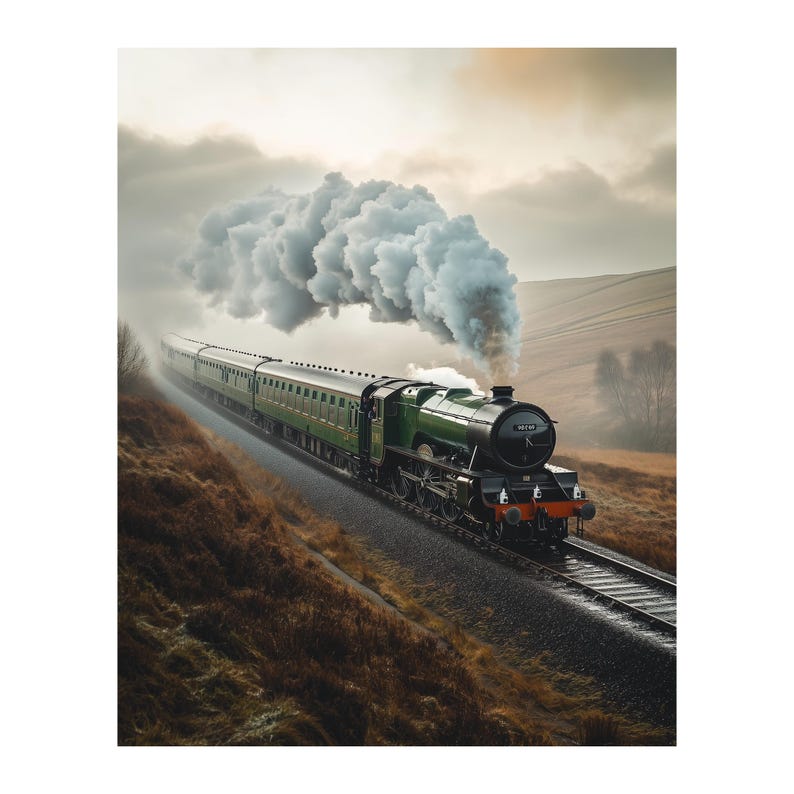
Then, in 1934, Flying Scotsman became the first steam locomotive in Britain officially recorded at 100 miles per hour. Apple-green paint, driving wheels taller than your kitchen counter, and a century of celebrity — there's a reason it may be the most recognized locomotive on Earth, and a reason it was one of the first railroad subjects we ever drew for the shop — the very print shown here.
The Santa Fe Super Chief: glamour on rails
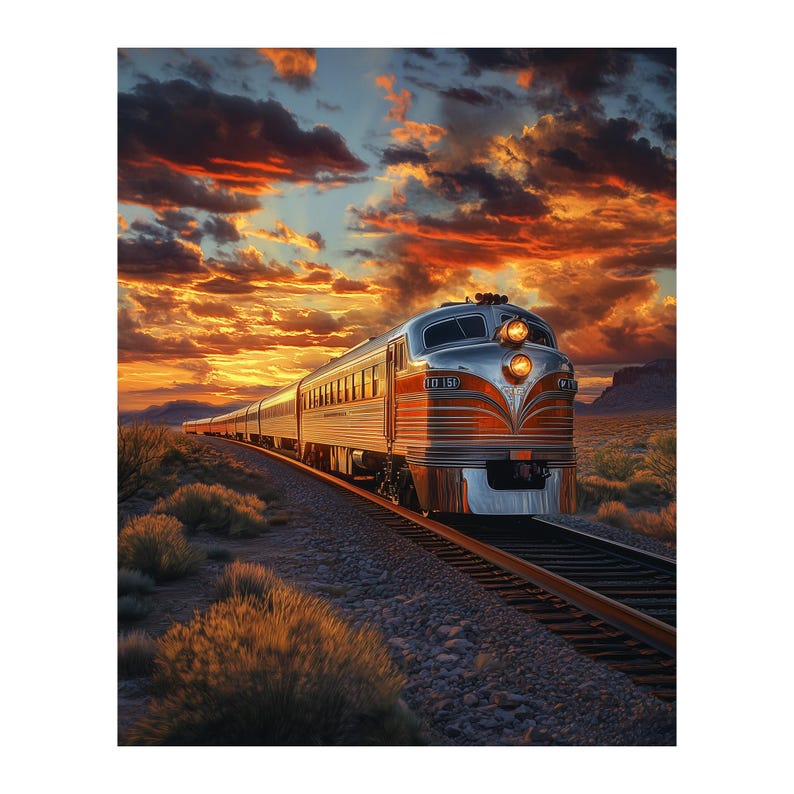
The Super Chief was a train rather than a single locomotive, and — purists, stand down — it was diesel-hauled from its very first run on May 12, 1936, covering Chicago to Los Angeles on a schedule of 39 hours and 45 minutes. In 1937 the Santa Fe added the all-lightweight stainless-steel streamliner that made the name immortal.
Hollywood's biggest stars rode it so often the press called it "The Train of the Stars," and its red-and-silver warbonnet paint scheme, created by General Motors artist Leland Knickerbocker, became one of the most beautiful liveries ever applied to a machine. I'd put it up against any airline paint job of the jet age — and I say that with genuine affection for airline paint jobs.
Our Five Legendary Trains chart gathers blueprint-style portraits of Big Boy No. 4014, the Flying Scotsman, and the Super Chief in its warbonnet colors on a single print — drawn at the same drafting table, in the same hand, as our aviation prints.
See the Five Legendary Trains chartThe Pennsylvania GG1: the electric that earned its place
Yes, the GG1 is electric, not steam — which is exactly why this list is about legendary locomotives, full stop. Between 1934 and 1943 the Pennsylvania Railroad put 139 of them into service, and industrial designer Raymond Loewy refined the design into an icon: a smooth welded body instead of riveted panels, dressed in five gold pinstripes sweeping down its Brunswick-green flanks.
At 79 feet 6 inches and rated at 4,620 continuous horsepower, GG1s ran passengers at 100 miles per hour between New York, Washington, and Harrisburg.
Here is the part that gets me: the last GG1 wasn't retired until 1983 — nearly half a century of front-line service. In my world we called airframes like that "honest airplanes." The GG1 was an honest locomotive.
Norfolk & Western No. 611: the Queen of Steam
My Southern-based bias may be showing, but No. 611 belongs on any list like this. The Norfolk & Western built its streamlined Class J 4-8-4s in its own Roanoke shops — no outside builder — and No. 611 emerged in May 1950, late enough in the steam era to benefit from everything the N&W had learned.
Behind that bullet nose sat a machine developing over 5,100 horsepower, capable of 110 miles per hour, with 80,000 pounds of tractive effort.
Restored once in 1982, she pulled excursions until 1994, then went cold. The "Fire Up 611!" campaign brought her back to steam in the spring of 2015, and tens of thousands of people lined the rails that May to watch her run home to Roanoke. Machines don't usually get second acts. She's had two.
Great machines have a way of outliving the era that built them. That, more than anything, is why we hang them on the wall.
Bringing the legends home
Jill and I have hung train art in three kinds of rooms over the years, and each one asks for something different.
Offices and dens
A locomotive print does the same work in a study that a warbird print does: it says something about craftsmanship without saying a word. Navy blueprint-style pieces — a Big Boy side elevation, a steam locomotive cutaway, a roundhouse scene — sit especially well beside dark wood and leather.
If you're building out a dedicated space, our guide to man cave wall art ideas covers layouts, groupings, and how to mix rail and aviation subjects on one wall.
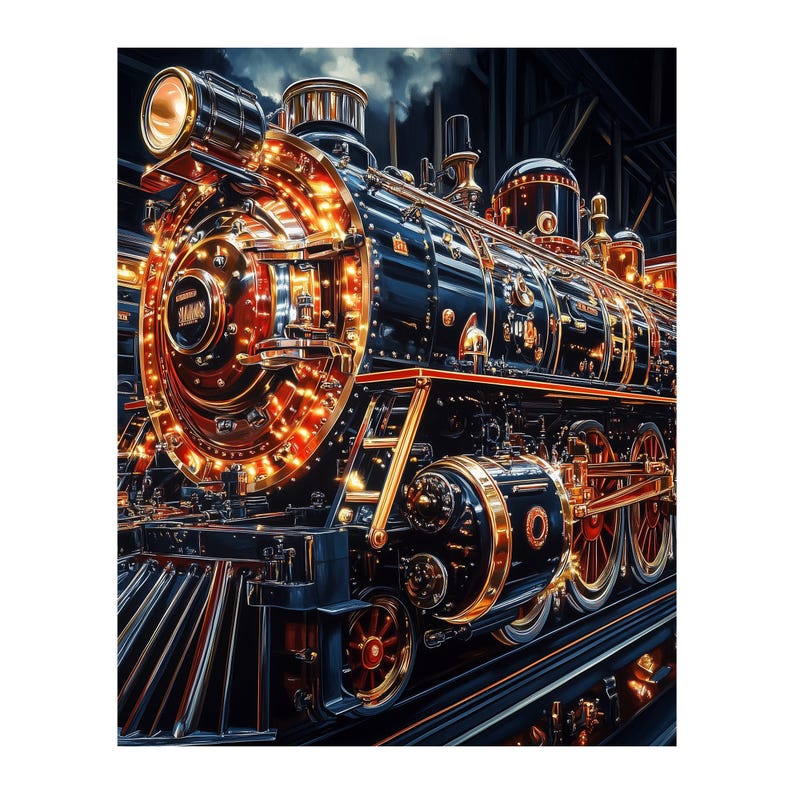
Kids' rooms and nurseries
Nothing on Earth loves a train like a four-year-old. Our locomotive evolution charts and blueprint prints give that obsession something to grow into — art that works at four and still works at fourteen.
The same approach we describe in our aviation nursery ideas post applies straight across: pick one hero image, keep the palette calm, and let the machine be the star.
Because most of our railroad pieces are instant digital downloads, you can print a test size at home before committing to a large frame. If you're new to that workflow, our step-by-step guide on how to print digital downloads walks through sizing, paper choice, and where to get large formats printed affordably.
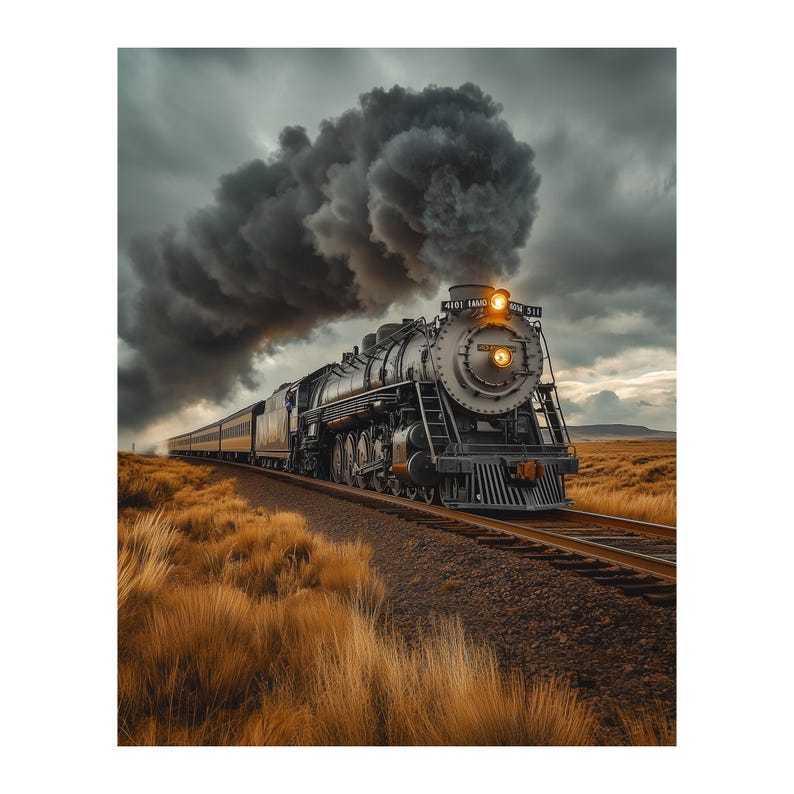
Beyond the individual legends, we also draw steam locomotive cutaways, evolution charts tracing a century of motive power, and roundhouse scenes — quieter pieces that reward a second look, in offices and kids' rooms alike.
Browse all railroad printsWhy these five endure
A Big Boy, a Scotsman, a streamliner, an electric in gold pinstripes, and the Queen of Steam. Different countries, different power, different eras — but every one of them was the product of people who cared about doing a thing completely.
That's what I chased for thirty-five years of flying, it's what Jill and I chase at the drafting table, and it's what these machines still radiate from a frame on the wall. Elevated craft, enduring legacy. The locomotives got there first.