When Greg retired from the airlines after thirty-five years, I assumed the airplanes might finally stay at the airport. Instead they followed him home to the drawing table — and from there, to my genuine delight, into the nurseries of families we've never met.
Some of my favorite customer notes begin exactly the same way: "We're decorating a room for a little aviator…"
If that's you, welcome. This is the guide I wish I could tuck into every order: how to build an aviation nursery that feels warm and collected instead of cartoonish, what actually works on the wall above a crib, and how to choose art that will still belong in the room when your baby becomes a first grader with strong opinions.
Start with the palette: navy, cream, and brass
Almost every aviation nursery we help with lands on some version of the same trio. Deep navy grounds the room and reads "night flight" rather than "baby blue." Warm cream keeps things soft and gives line art somewhere to breathe.
Brass — in a curtain rod, frame corners, a small ceiling light — adds the glow of old cockpit instruments and leather flight jackets. It's a palette borrowed from real aviation, not from a licensed cartoon character, and that's exactly why it never feels dated.
You don't need to commit to four navy walls. Our favorite version is one navy accent wall behind the crib (or navy below a chair rail) with the rest kept cream, so the room stays bright during the day.
If a whole navy wall feels heavy, keep the walls warm white and bring the navy in through art, curtains, and a rug. Prefer something gentler still?
Sage green with walnut furniture gives a lovely vintage-airfield feel and pairs beautifully with cream blueprint prints. Whatever you pick, tape swatches to the wall and look at them at night by lamplight — that's the light you'll actually be rocking a baby in.
A nursery doesn't need more stuff to feel special — it needs a few things that mean something.
Choose blueprint-style prints over cartoon decor
Here's the case I make to every expecting parent who asks: cartoon decals are the fastest way to date a room, and most kids outgrow a character before they outgrow the crib sheets. Blueprint-style art solves both problems.
The crisp, high-contrast line work is genuinely engaging for young babies, who are drawn to bold, high-contrast patterns long before they can see subtle pastels — and to the adults in the room, it reads as considered, graphic, and calm.
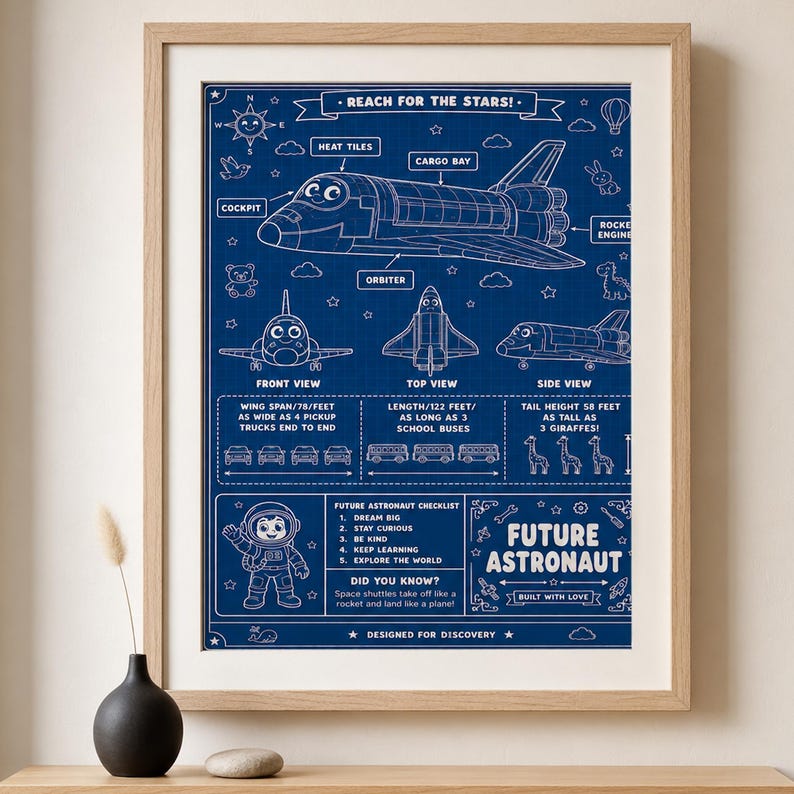
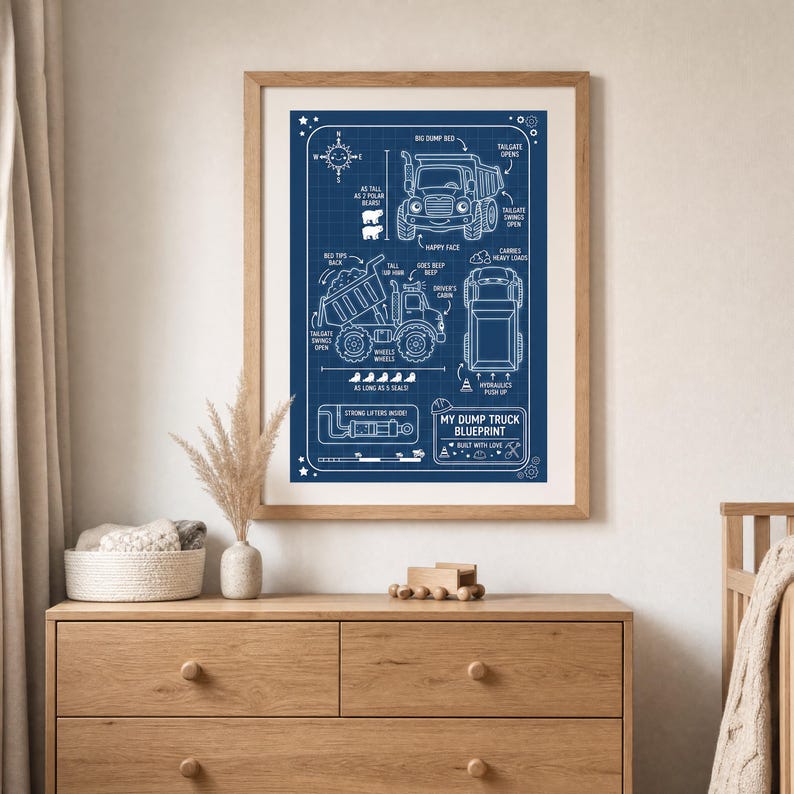
This is the corner of the shop closest to our hearts. Greg draws our blueprint nursery vehicle prints — airplanes, steam trains, rockets, fire trucks, and more — the way he once studied aircraft manuals, except now the hero drawing wears a friendly little face.
Each design carries labeled callouts pointing to the real parts (propeller, rudder, landing gear), size comparisons, and a "Future Pilot" checklist along the bottom. He is a stickler about proportions; a wing that's drawn wrong simply doesn't leave the studio.
It's the sweet spot we were always looking for as gift-givers ourselves: playful enough for a child, handsome enough to hang anywhere in the house — the rocket and dump truck shown here are two favorites from the series.
What to look for in blueprint nursery art
Whether you buy from us or anyone else, the same checklist applies. Look for consistent line weight and a restrained palette, so multiple prints hang together as a set.
Look for labeled details — they turn a print into a conversation. Look for honest proportions, because kids eventually notice.
And look for a series in a matching style, so the wall grows one frame at a time and still feels curated.
Our blueprint nursery series — planes, trains, rockets, and more, each with a cute face, labeled callouts, and a Future Pilot checklist — is drawn by Greg, a retired airline pilot. The Rocket Blueprint print is available as an instant digital download and print.
See the Rocket Blueprint printPlan the gallery wall over the crib — safely
The wall above the crib is usually the biggest blank canvas in the room, and a few layouts work almost every time. A single statement print, sized generously and centered on the crib (not on the wall), is the simplest and often the most striking.
A row of three coordinated prints is the classic — say, an airplane flanked by a star chart and a hot-air balloon. A grid of four suits a wider wall, and an ascending "staircase" arrangement that climbs like a takeoff path adds a bit of motion. Keep 2–3 inches between frames so the group reads as one composition.
One more practical note: this is where digital downloads earn their keep. You can print the same design small for a shelf and large for the statement wall, and reprint as the room evolves.
Our walkthrough on how to print digital downloads covers paper choices, sizing, and where to order affordable enlargements.
Mix vintage aviation with modern nursery furniture
The rooms that photograph best — and live best — keep the furniture simple and modern and let the art and small objects carry the vintage character. A clean-lined crib and a neutral glider give the eye somewhere to rest; then a framed flight map, a shadow box with grandpa's wings, or a wooden propeller mounted securely on the far wall does the storytelling.
One true heirloom is worth ten themed accessories, which is more or less our whole company in a sentence.
And don't overlook the stories themselves. Aviation history is full of heroes worth growing up with — for girls and boys alike.
Bessie Coleman, turned away by American flight schools, learned French and earned her international pilot's license in France on June 15, 1921 — the first African American woman to do so. We tell her whole remarkable story in our Bessie Coleman post, and a portrait print of a pioneer aviator makes a nursery wall quietly aspirational.
The air is the only place free from prejudices. — Bessie Coleman
Choose art that grows from nursery to big-kid room
The most budget-friendly nursery is the one you only decorate once. This is the quiet superpower of blueprint-style art: because it was never babyish to begin with, it survives every furniture transition.
Swap the crib for a toddler bed and then a twin, and the same navy wall and the same airplane print carry straight through. The Future Pilot checklist that was just a cute graphic at six months becomes early reading practice at five years, and those labeled callouts start answering real "how does it fly?" questions.
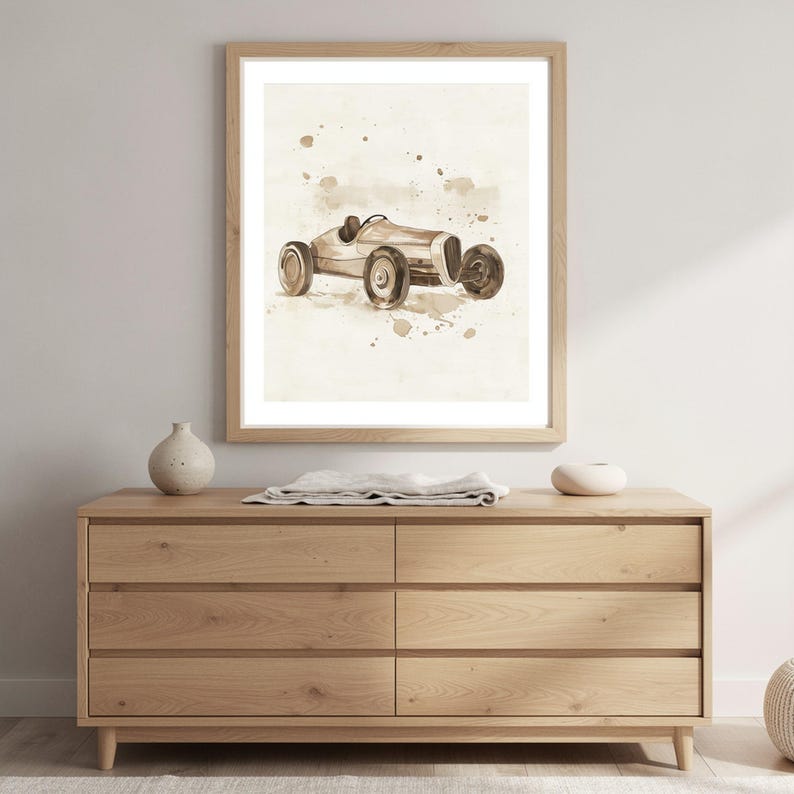
My practical advice: start with your largest size, keep the frames, and let the art rotate. A rocket print can move over the desk when a new favorite — like the vintage race car shown here — takes the spot above the bed.
Because our designs share one drafting style, pieces added years apart still hang like a matched set — which is precisely the "collected over time" look that makes a room feel like it belongs to the child, not the catalog.
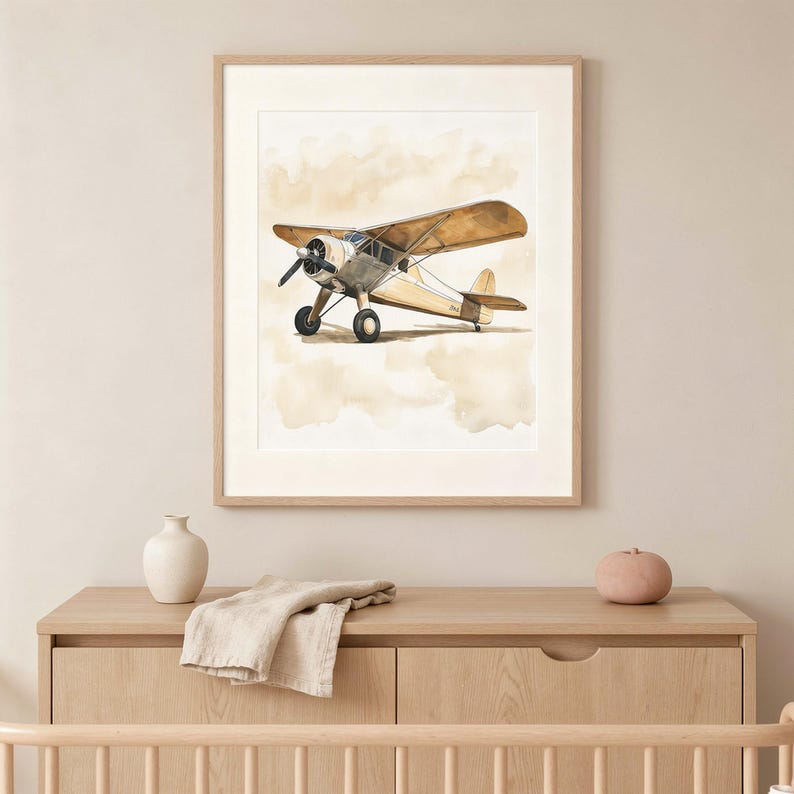
Every design at Runway & Heirloom is an original by a pilot with 35 years in the left seat — blueprint nursery prints, warbirds and jets, women-in-aviation portraits, and printable aviation cards for the day your little aviator turns one.
Browse all nursery printsCleared for takeoff
Start with the palette, hang one piece you truly love over the crib (safely), add real stories instead of licensed characters, and choose art that's ready to grow up alongside its owner. That's the whole flight plan.
And if one of Greg's little airplanes ends up watching over a crib in your house, send us a photo. He'll tell you it's about the drawings, but I've seen his face when those pictures arrive — it's the best part of this job. — Jill