The question we hear more than any other at Runway & Heirloom has nothing to do with airplanes. It's some version of: "I love the art — now how do I get it onto my wall?" If you've just bought your first digital download on Etsy, or you've been hesitant to try one, this guide is for you.
I'll walk you through exactly how instant downloads work, how print sizes and ratios fit together, where to have your art printed, and how to frame it beautifully without spending more than you did on dinner.
How Etsy Instant Downloads Actually Work
A digital download is exactly what it sounds like: instead of shipping you a finished print, the seller delivers print-ready files the moment your payment clears. To find yours, sign in at Etsy.com and go to Your Account → Purchases, then click Download Files next to the order.
If you checked out as a guest, the download link is in your receipt email. Nothing arrives in the mail — the artwork is yours within minutes, and in most cases you can return to your Purchases page and re-download the files whenever you need them.
Why buy art this way? Speed and value, mostly.
There's no shipping cost, no waiting by the door, and no bent corners in transit. You can print the same file at 5x7 for a desk frame today and at 24x36 for the den next year.
It also means you can simply reprint when a certain small copilot "improves" the first copy with a crayon. Ask me how I know.
The Print Ratio System, Decoded
Here's the single most useful thing to understand about printable wall art: frames come in families, and every frame in a family shares an aspect ratio — the proportion of width to height. A file made in the right ratio prints at every size in its family with no cropping and nothing stretched. That's why a well-prepared listing gives you several files instead of one.
2:3 — the statement-print family
Covers 4x6, 6x9, 8x12, 12x18, 16x24, 20x30, and 24x36. This is the classic photographic proportion, and the family to reach for when you want a large focal-point print over a sofa, bed, or workbench.
3:4 — the balanced middle
Covers 6x8, 9x12, 12x16, and 18x24. Slightly stockier than 2:3, and home to the ever-popular 18x24 poster frame.
4:5 — the everyday workhorse
Covers 4x5, 8x10, and 16x20. The 8x10 is probably the most common frame in American closets, which makes this the ratio you'll likely print first.
11x14 — a family of one
The 11x14 frame uses its own proportion that no other common size shares, and it's far too popular to ignore — so it gets a dedicated file rather than an awkward crop.
A-series — the international standard
A5, A4, A3, A2, and A1 are the ISO paper sizes used across most of the world outside North America. Every A-size shares the same ratio, so a single A-series file scales cleanly from a small A5 all the way up to a poster-sized A1.
Buy the frame you love first. Then print the file that matches it — never the other way around.
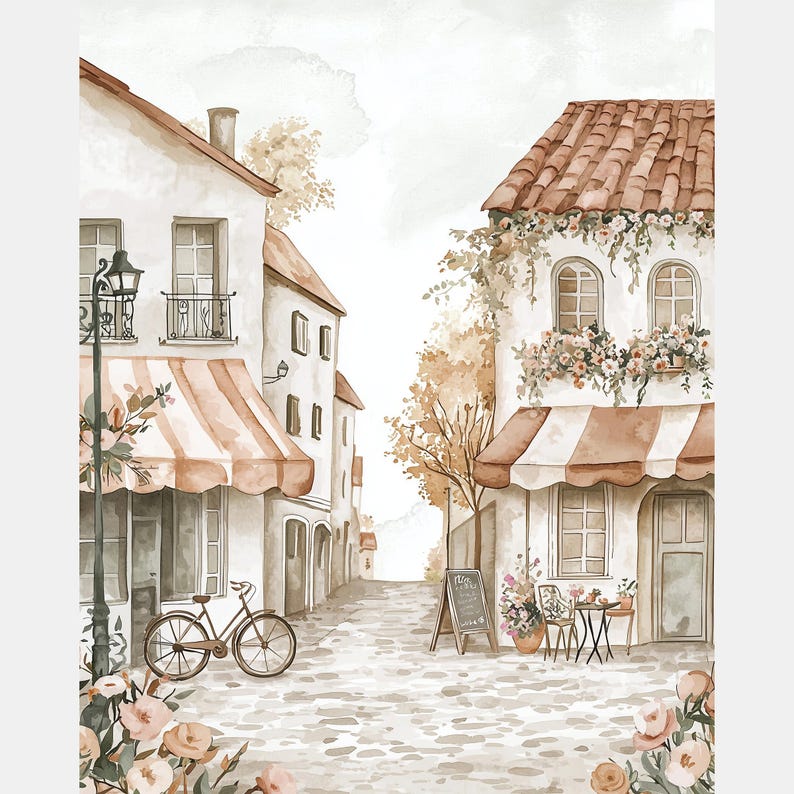
Every digital listing at Runway & Heirloom — like this Paris cafe watercolor — includes five print-ready files: 2:3, 3:4, 4:5, 11x14, and A-series, all at 300 DPI, sized to fit standard frames from 4x6 up to 24x36 and A1. Whatever frame you already own, one of the five drops straight in.
Browse printable wall artWhere to Print: Home, Drugstore, or Online Lab
Printing at home
A decent inkjet and a pack of good photo paper will handle sizes up to 8.5x11 — or 13x19 if you own a wide-format model. Home printing shines for greeting cards, gallery-wall fillers, and desk frames.
Use paper made for your printer brand, select the highest quality setting, and let prints dry before framing. Just know that ink costs add up; beyond about 8x10, a print shop is usually cheaper.
Drugstore and big-box photo centers
The photo counters at national pharmacy and supercenter chains are the fastest option: upload the file on their website, choose your size, and pick it up the same day, often within the hour. Prices are modest and quality is genuinely good for small and mid-size prints.
One tip from experience: if the ordering screen offers "auto-enhance" or color correction, turn it off. Those filters are tuned for snapshots of birthday parties, not artwork.
Office-supply and shipping stores
For larger formats, office-supply print counters are a quiet bargain — many will produce crisp poster-size prints on sturdy stock for less than you'd expect, and the staff will flag a file problem before it ever hits paper.
Online professional labs
When a print is destined for the living room wall, a dedicated online photo lab is worth the few days' wait. Pro labs offer superior color accuracy, heavier fine-art papers, and giclée options, and they ship large prints flat or carefully rolled.
You'll pay more than the drugstore, but still a small fraction of what finished art costs.
Matte or Luster? Choosing Your Paper
Most print services will ask you to pick a finish, and for wall art the real contest is between two. Matte has a soft, non-reflective surface with no glare from any angle — the fine-art look, and the safe choice for brightly lit rooms or anything going behind glass.
Luster carries a gentle sheen that deepens color and resists fingerprints, though it can catch light from a window at certain angles. Glossy is best skipped for framed art; it turns into a mirror the moment the sun comes through.
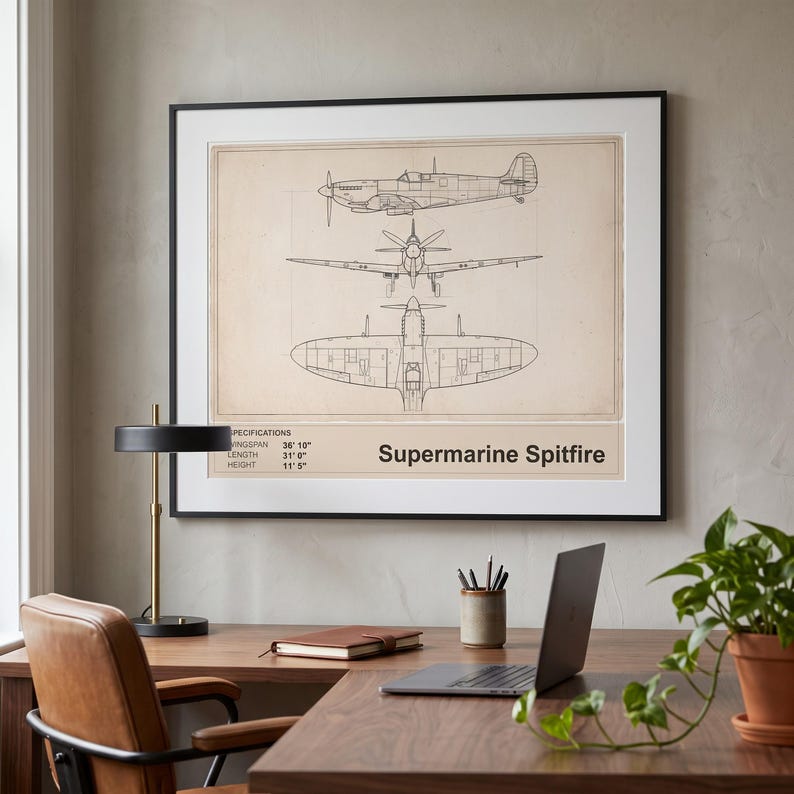
For our own designs — vintage aircraft, locomotives, blueprint-style prints, and soft watercolors, like the two examples shown here — we recommend matte every time. That drafting-table character is exactly what a low-sheen paper preserves.
300 DPI, Explained Simply
DPI stands for dots per inch — how much detail the printer lays down for every inch of paper. 300 DPI is the professional standard for sharp printing. The math is friendly: an 8x10 print at 300 DPI needs a file that's 2400 x 3000 pixels.
A file built at 300 DPI for its largest listed size will also print crisply at every smaller size in the same ratio family.
Two practical notes. First, don't judge a file by zooming to 400% on your screen — no print is viewed from two inches away.
Second, resist the urge to stretch a file beyond its intended maximum; that's where softness creeps in. If a listing states its files are 300 DPI at the largest print size, you're set.
Framing and Matting on a Budget
Here's the payoff of the whole ratio system: every size mentioned in this guide matches an off-the-shelf frame from any big-box store, discount retailer, or craft shop. No custom framing required — ever.
Want the custom-framed look anyway? Use a mat.
Print one size down and frame one size up: an 8x10 print floats beautifully inside an 11x14 frame with a pre-cut mat, and an 11x14 print does the same in a 16x20. Pre-cut mats cost a few dollars and instantly make a ten-dollar print read like gallery work.
And don't overlook thrift stores — solid wood frames turn up constantly for pocket change. Keep the frame, replace the art.
If you're deciding where all this newly printed art should go, we've written room-by-room guides to help: start with our aviation nursery ideas for the littlest aviator's room, or head to the other end of the hangar with our man cave wall art guide.

Ready to put a wall together? Every print in our shop — warbirds, steam locomotives, muscle cars, watercolors like this hummingbird, and blueprint nursery art — is an original design by Greg, drawn from 35 years in the left seat, and every digital listing arrives with all five ratio files at 300 DPI.
Find your next printPrinting your own art isn't a compromise — it's how you get exactly the size, paper, and frame you want, at a price that lets you build a whole gallery wall instead of buying a single piece. Download the files, match the ratio to the frame, choose matte, and order that little test print first. Your walls are about to earn their wings.