Somewhere over the Somme estuary in the spring of 1921, a Texas sharecropper's daughter was learning to bring a biplane down onto a grass strip while her instructors called out corrections in French — a language she had started studying at night, in Chicago, for exactly this purpose. Her name was Bessie Coleman, and by the middle of June she would hold something no Black woman in the world had ever held: a pilot license.
I flew airliners for thirty-five years. I sat through more checkrides than I care to count, and not once did I have to wonder whether the schoolhouse door would open for me.
Bessie Coleman knocked on every one she could find, was turned away from all of them, and decided the problem wasn't her — it was the doors. That's why her portrait hangs in our studio, and why we keep drawing her.
From a Texas Cotton Field to a Chicago Barbershop
Bessie Coleman was born on January 26, 1892, in Atlanta, Texas, the tenth of thirteen children. Her parents were sharecroppers, and the family soon settled in Waxahachie, south of Dallas, where Bessie picked cotton, helped with the wash her mother took in, and walked miles to a one-room segregated school.
She was, by every account, ferociously good at arithmetic. She saved enough for a single term at the Oklahoma Colored Agricultural and Normal University — today's Langston University — before the money ran out.
In 1915, at twenty-three, she joined her brothers in Chicago and found work as a manicurist in a barbershop on the South Side. The timing mattered.
Veterans came home from the First World War full of flying stories, and one of her brothers reportedly needled her that women in France were flying airplanes while she was doing nails. Whatever the exact words, something caught. Bessie Coleman decided she was going to fly.
When Every Flight School Said No
American aviation in 1920 had no room for her — flight schools would not admit a Black student, and most would not admit a woman. She was both, so she was turned away twice over at every field she tried.
Robert S. Abbott, the publisher of the Chicago Defender, gave her the advice that changed everything: go to France, where the flying schools would judge her by her hands and feet on the controls.
With encouragement from Abbott and financial backing that included the banker Jesse Binga, Coleman enrolled in French classes at a Berlitz school in Chicago, saved what she could, and sailed for France in November 1920.
She trained at the Caudron Brothers' School of Aviation at Le Crotoy, on the Somme coast, completing a course in about seven months. On June 15, 1921, the Fédération Aéronautique Internationale issued her its license — making Bessie Coleman the first African American woman, and also the first woman of Native American descent, to earn a pilot license.
She then went back to Europe for advanced aerobatic instruction, because a license alone wouldn't fill grandstands, and Bessie understood the arithmetic of her situation as well as she'd understood the arithmetic in that one-room school.
The air is the only place free from prejudices. — Bessie Coleman
Queen Bess, the Barnstormer
Coleman made her American air show debut on September 3, 1922, at Curtiss Field on Long Island, at an event honoring veterans of the all-Black 369th Infantry Regiment. The Black press crowned her "Queen Bess," and for the next four years she earned her living the hard way: loops, figure eights, steep dives, and low passes in war-surplus Curtiss JN-4 "Jenny" biplanes, flown in front of paying crowds from New York to Texas to California — the era we set out to capture in the two prints shown here.
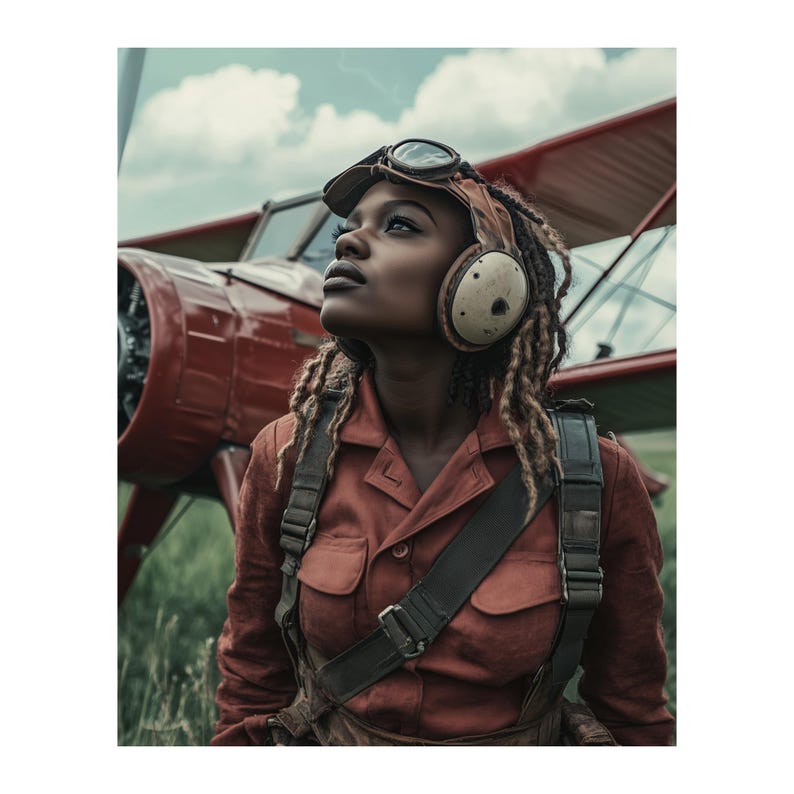
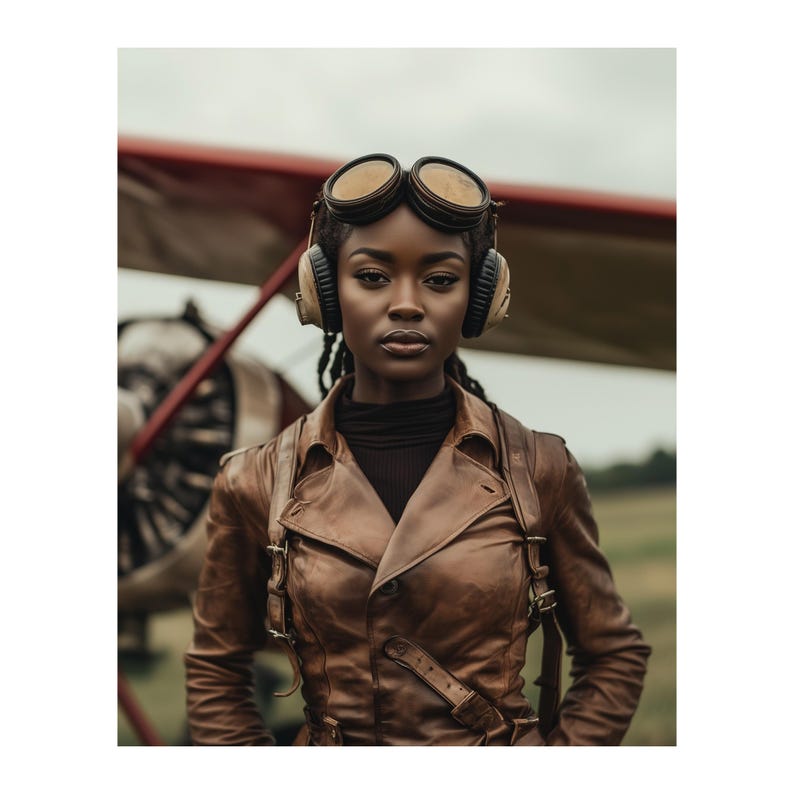
She was as principled as she was fearless. Coleman refused to perform at events that would not admit Black spectators, and between shows she lectured in theaters, schools, and churches, telling Black audiences that the sky was theirs too.
Her great unfinished dream was a flight school of her own, open to Black students who faced the same locked doors she had.
The risks were real. In February 1923 a crash near Santa Monica put her in the hospital with a broken leg and broken ribs. Her response, sent to friends and supporters, has become the most famous line she ever produced:
Tell them that as soon as I can walk I'm going to fly! — Bessie Coleman, from her hospital bed, 1923
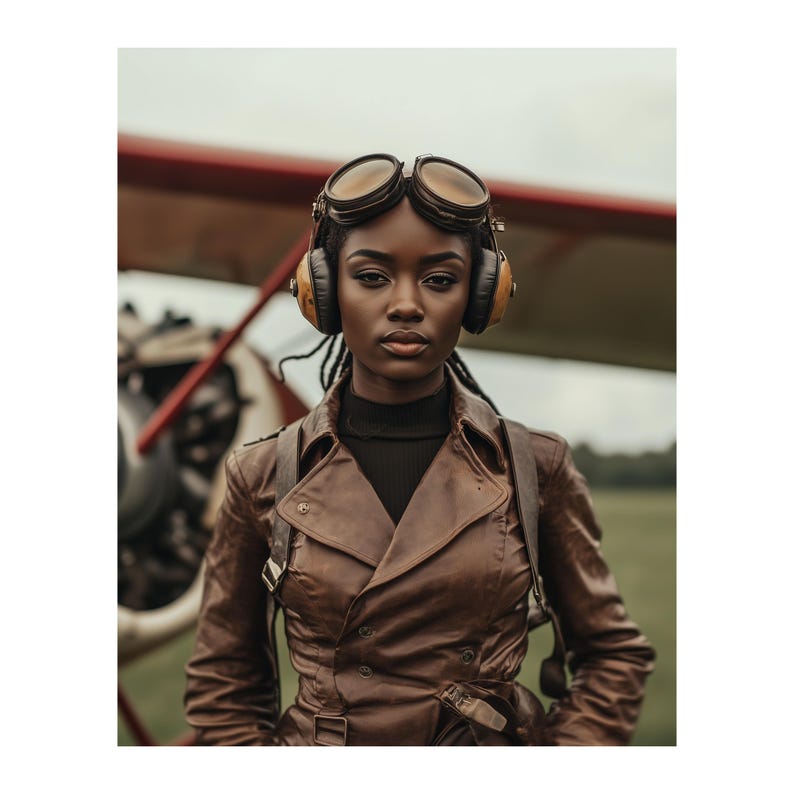
Our studio's Bessie Coleman poster — the piece at the top of this story — is part of a wider Women in Aviation collection of aviatrix portraits and WASP art that Jill and I have been building for years. Every piece starts as my own drawing, not a stock image.
See the Bessie Coleman printJacksonville, April 30, 1926
Coleman's last flight was a reconnaissance hop over Jacksonville, Florida, the day before a scheduled show. Her mechanic and publicity agent, William Wills, was flying the newly purchased Jenny while Coleman rode the other cockpit unbuckled, leaning out to study the field below for a parachute jump planned for the next day.
Roughly ten minutes in, the airplane suddenly dove and spun. Coleman was thrown from the aircraft and killed; Wills died when the Jenny hit the ground.
In the wreckage, investigators found that a loose wrench had slid into and jammed the control mechanism.
She was thirty-four. Thousands mourned her at services in Florida, and in Chicago an estimated ten thousand people paid their respects at a memorial led by the journalist and activist Ida B. Wells.
The Legacy That Kept Climbing
The flight school Coleman dreamed of never opened in her lifetime — but her name built others. In 1929 William J.
Powell founded the Bessie Coleman Aero Club in Los Angeles, and he dedicated his 1934 book Black Wings to her. In Chicago, aviators like Cornelius Coffey and Willa Brown carried the torch into the flight-training programs that helped produce a generation of Black military pilots.
The women who ferried warplanes in the 1940s inherited the same fight; we told more of their stories in Women of the Flight Line.
The honors kept coming long after. A U.S. postage stamp in 1995.
Induction into the National Women's Hall of Fame in 2001 and the National Aviation Hall of Fame in 2006. A U.S. quarter in 2023.
And at Chicago O'Hare — an airport I flew into more times than I could ever tally — the road that carries crews and travelers to work is named Bessie Coleman Drive. I never once drove it without thinking about a manicurist who taught herself French because America wouldn't teach her to fly.
Why Bessie Belongs on Your Wall
We hear from two kinds of buyers about our Coleman prints. The first is decorating an office or study — they want the reminder that every locked door has a workaround, rendered in ink rather than a motivational poster font.
The second is decorating a child's room, and that's the one that gets me. A kid who grows up under Bessie Coleman's gaze learns her story the way kids learn everything on their walls: slowly, permanently.
If you're building an aviation-themed room from scratch, our guide to aviation nursery ideas shows how a historical portrait can anchor a wall of blueprint prints.
And if you're shopping for the pilot in your life — student, professional, or armchair — a Queen Bess print is the rare gift that works for all three. We put her on the shortlist in our pilot gift guide for exactly that reason.
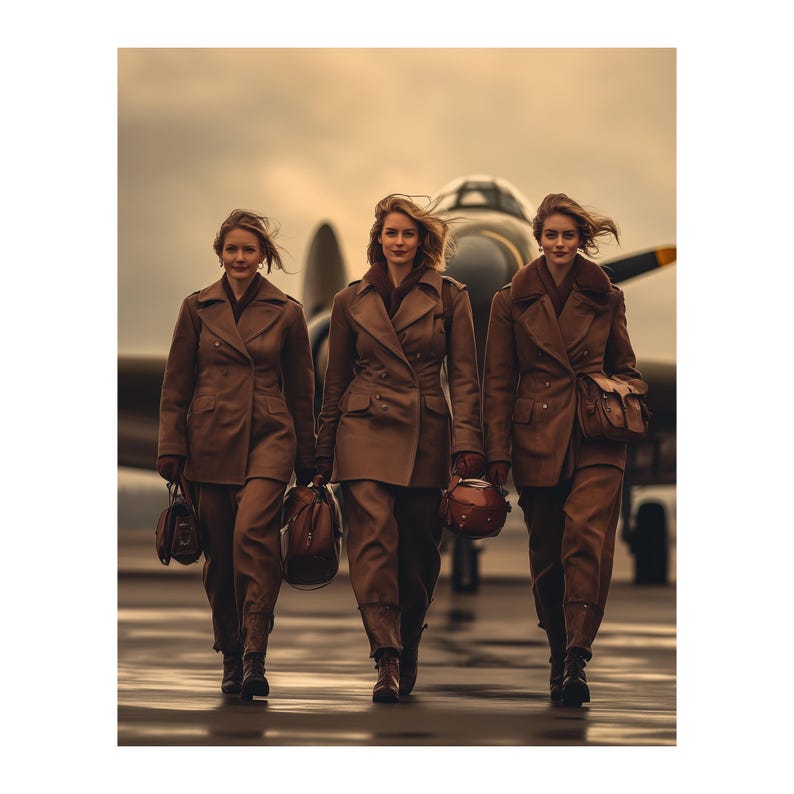
All three Bessie Coleman designs are available as instant digital downloads or ready-to-hang prints, alongside the rest of our Women in Aviation collection. Print one for the office, one for the nursery — Queen Bess earned both walls.
Browse the Women in Aviation collectionAviation hands out its honors sparingly, and history hands them out late. Bessie Coleman got five years in the air and nearly a century of being under-remembered.
But stand a child in front of her portrait and tell the story — Texas cotton field, Chicago barbershop, Berlitz classroom, a grass strip on the Somme — and watch it land. That's why we make these prints. Some legacies deserve wall space.