Thirty-five years in an airline cockpit teaches you which stories get told too often and which are never told enough. This one belongs to the second group.
Between 1942 and 1944, just over 1,100 American women strapped into everything from open-cockpit trainers to heavy bombers and flew more than 60 million miles for a country that would not call them veterans for another 33 years. They were the Women Airforce Service Pilots — the WASP — and every woman who has ever taxied out with four stripes on her shoulders is flying in their slipstream.
It is one of the great undertold chapters of women in aviation history, and it deserves a place on the wall, not just in the footnotes.
Before the WASP, a runway in France
The story doesn't begin in 1943. It begins, in many ways, on June 15, 1921, when Bessie Coleman — turned away by American flight schools because she was both Black and a woman — earned her international pilot's license from the Fédération Aéronautique Internationale after training in France.
She had to cross an ocean to get a certificate her own country wouldn't let her earn at home. We've told her full story in The Bessie Coleman Story, and her portrait hangs in our studio as a daily reminder of what stubborn courage looks like.
Through the twenties and thirties, women kept forcing the hangar door open: air racers, barnstormers, flight instructors. By the time the Second World War arrived, America had a small but seasoned corps of licensed women pilots. What they lacked wasn't skill. It was permission.
Sweetwater, 1943: silver wings at Avenger Field
Permission finally came from two directions at once. In 1942, Nancy Harkness Love organized experienced women pilots into the Women's Auxiliary Ferrying Squadron, while Jacqueline Cochran built the Women's Flying Training Detachment to train new ones from scratch.
In August 1943 the two programs merged into a single organization: the Women Airforce Service Pilots.
More than 25,000 women applied. Only a fraction were accepted, and just 1,074 made it all the way through training to earn their wings — joining the 28 seasoned pilots of Love's original squadron for a total of 1,102 women who flew as WASP.
Training ran through Avenger Field in Sweetwater, Texas — the only all-female flight training base in the country — where trainees flew the same demanding Army curriculum as male cadets, working up from primary trainers to the 600-horsepower AT-6 Texan. The washout rate was steep, the west Texas wind never quit, and the women had even paid their own way to get there.
Sixty million miles, thirty-eight names
Graduates scattered to bases across the country and went straight to work. Between September 1942 and December 1944, the women delivered 12,650 aircraft — 78 different types, from primary trainers all the way up to the B-29 Superfortress — and logged more than 60 million miles.
They ferried factory-fresh fighters, towed gunnery targets while trainees fired live ammunition at the sleeve behind them, flight-tested repaired airplanes, and hauled cargo and personnel wherever the Army Air Forces needed wings.
Thirty-eight of them died in that service. Because the WASP were classified as civilians, those women received no military honors and no benefits.
No flag was permitted on the casket, and more than once classmates passed the hat to send a friend's body home to her family. When the program was disbanded on December 20, 1944, many of the women paid their own fare home from their final duty station.
Now in 1944, it is on the record that women can fly as well as men. — General Henry "Hap" Arnold, Commanding General of the Army Air Forces, at the final WASP graduation, December 1944
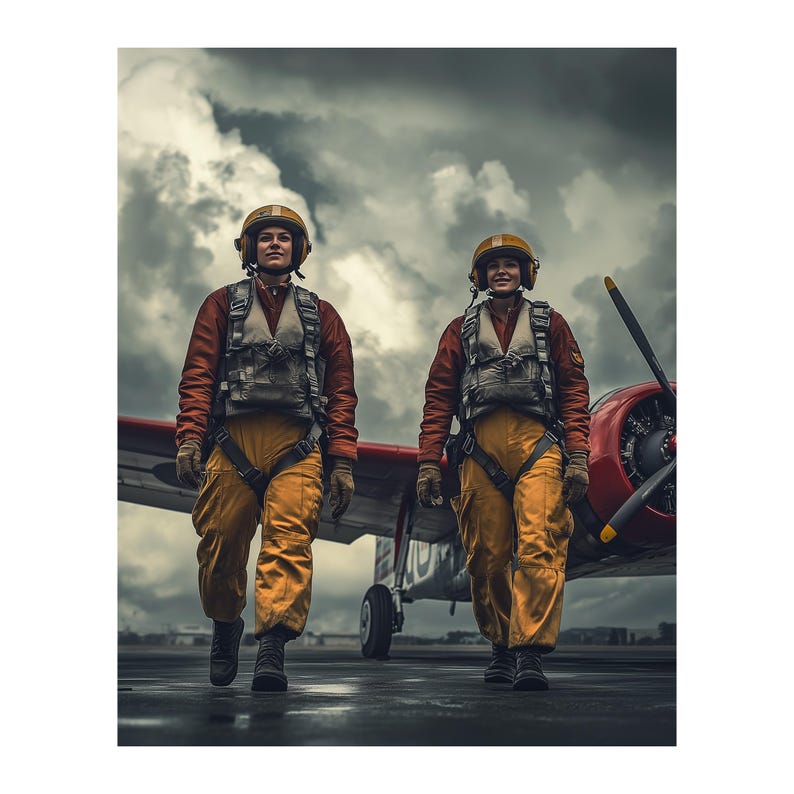
Our WASP Pilots tribute print is built around the silhouettes, silver wings, and quiet dignity of the women of Avenger Field — designed by a pilot, for the people who understand what those wings cost.
See the WASP tribute printThe long taxi to recognition
After disbandment, the records of the WASP program were tucked away for decades, and most of the women went back to lives in which almost nobody knew what they had done. It took a determined campaign by the surviving WASP and their allies before President Jimmy Carter signed legislation in 1977 — 33 years after the program ended — finally granting them veteran status.
The last formal honor came on March 10, 2010, when the WASP were collectively awarded the Congressional Gold Medal. About 200 surviving members, most of them in their late eighties and nineties, gathered in Washington to receive it. They had waited more than six decades to hear their country say thank you out loud.
The women I flew with
The WASP were sent home before the airlines would even consider a woman for the cockpit, and the wait stretched on for another generation. Not until 1973 did a modern U.S. scheduled airline hire a woman pilot — Emily Howell Warner, at Frontier Airlines — and on June 6, 1976, she became the first American woman to captain a scheduled airline flight.
I flew the line for 35 years, and I watched that door swing open in real time. Early in my career, a woman in the crew room was rare enough that passengers sometimes did a double take at the flight deck door.
By the end of it, I had shared cockpits, simulators, and checkrides with women who were, stick for stick, among the finest pilots I ever flew with — and I watched more than a few of them move to the left seat, put on the fourth stripe, and mentor the next wave coming up behind them. The double takes are gone.
The wings are just wings now, the way it should be — a lineage we've drawn in the two prints below.
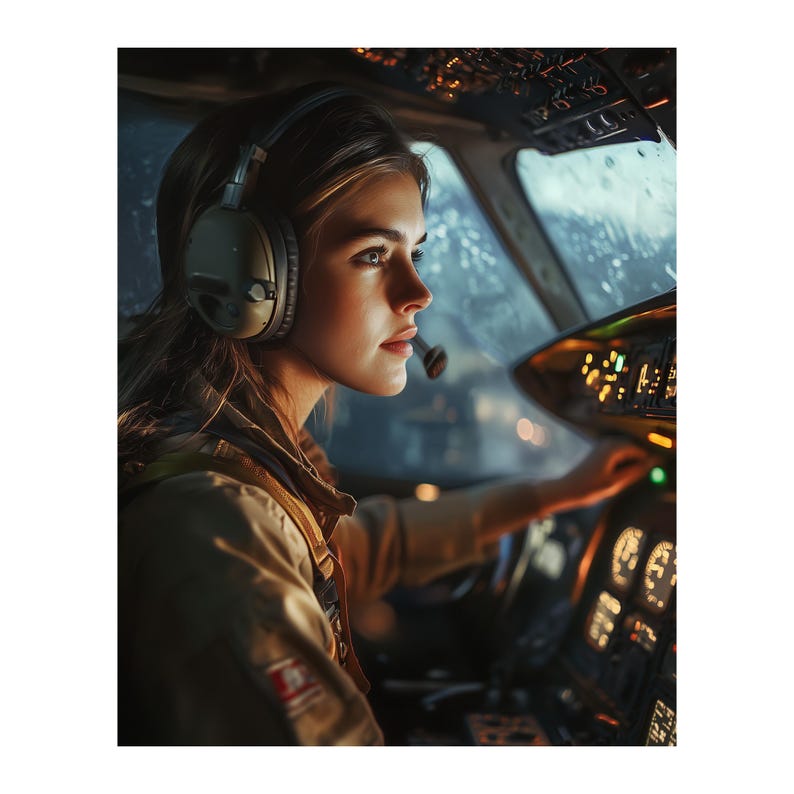
There's still runway ahead: even today, only a little over five percent of U.S. airline transport pilots are women, a threshold crossed for the first time in 2023. But the number climbs every year, and if the WASP teach us anything, it's that the line between "rare" and "unremarkable" is drawn by the women who keep showing up anyway.
Every set of wings is inherited. Someone had to fly first so that someone else could simply fly.
Art for the women earning their wings
This history is why women in aviation get a full wall in our studio, not a corner. We design cinematic portraits of women at work in the sky — a captain walking a rainy ramp before dawn, like the print shown here, the instrument glow of a cockpit on a sunset approach, a young aviator with her eyes already past the horizon — alongside our four-generations-of-aviators print, which traces a family's flying lineage from fabric-winged biplanes to the modern flight deck. Bessie Coleman is there too, in a portrait series we're especially proud of.
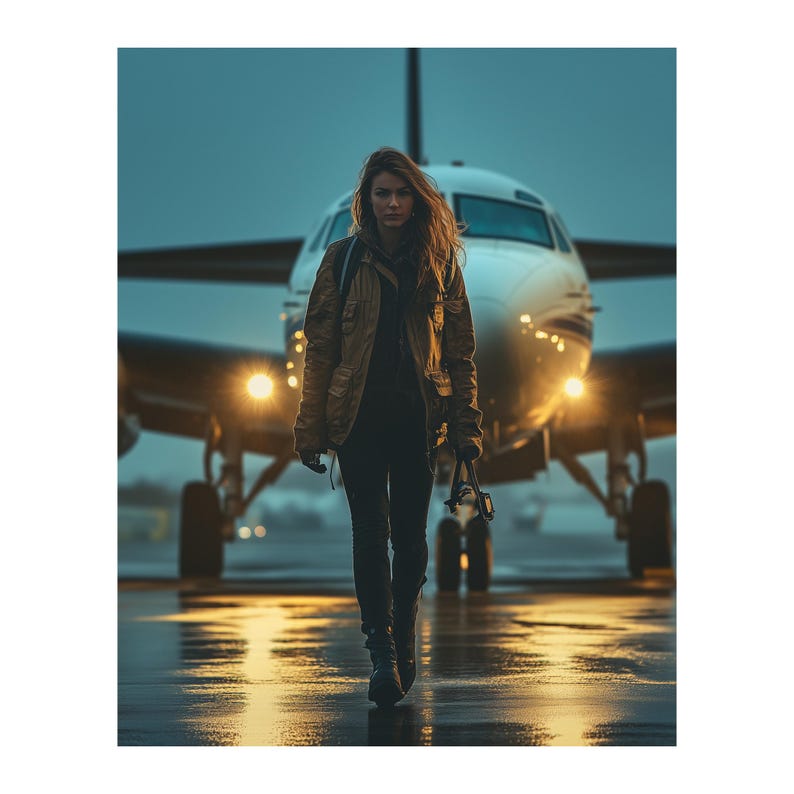
If you're looking for female pilot gifts that take her seriously as an aviator — for a first solo, a hard-won checkride, a new airline class date, or a retirement after a career in the left seat — art made by someone who has lived that life tends to be the gift that gets kept. We've collected our favorite ideas, by milestone and by budget, in The Pilot Gift Guide.
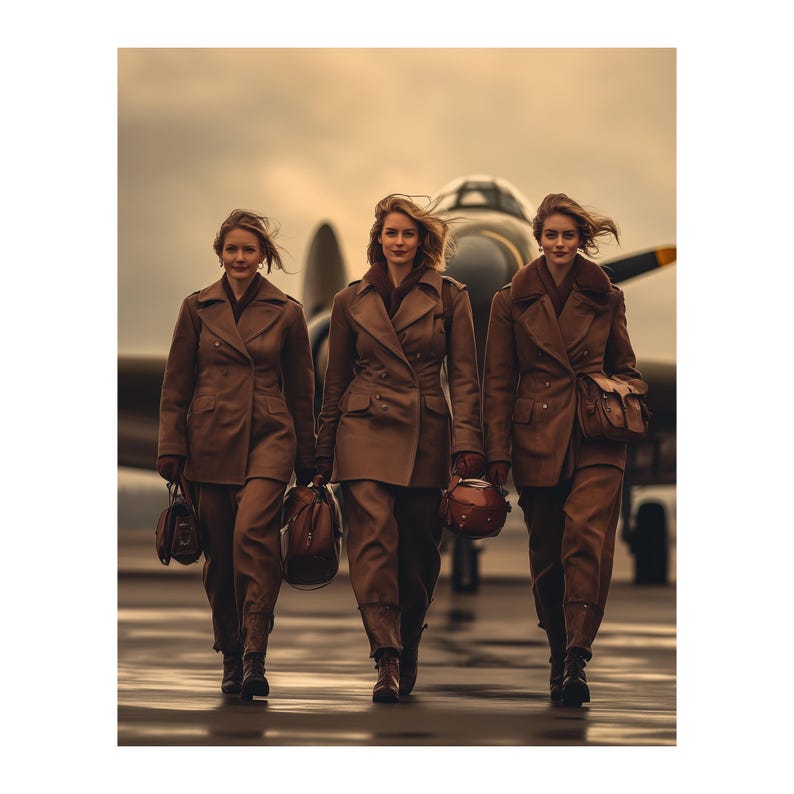
From WASP tribute prints to cinematic female pilot portraits and Bessie Coleman art, our Women in Aviation collection is designed by a retired airline pilot who flew alongside the women this history made possible.
Browse the Women in Aviation collectionSixty million miles later
The WASP asked for almost nothing — not rank, not benefits, not glory — except the chance to fly for their country. They flew 60 million miles on that chance, buried 38 of their own without honors, and then waited most of a lifetime for the recognition they had earned in 1944.
Along the way they handed the sky to their granddaughters. Around here, we call that an enduring legacy — and we'll keep drawing it as long as people keep earning their wings.